Meaning and usage at a glance
Meaning: fully focused or committed.
Tone: Informal and context-dependent. The speaker’s intent and the surrounding conversation matter.
Can it sound offensive? It is not inherently a slur in the sense described here. That does not make every joke or personal comment appropriate.
Other meanings and forms: It may literally mean secured inside, or mean a price or arrangement has been fixed. Focus is the slang sense.
Context: Describes concentration without promising a particular result.
Example conversation
A: I’m locked in until the exam.
B: Good. Let us finish without distractions.
An original illustrative exchange, not a quotation from a real conversation.
“Locked in” means fully focused, committed, or ready to give something your serious attention. If a friend says “I’m locked in for finals,” they mean they are concentrating on studying rather than getting distracted. “Lock in” is the related instruction: stop messing around and focus. The phrase is common in sports, gaming, school, work, and TikTok captions, and it can be sincere or joking depending on the context.
What does “locked in” mean in slang?
In everyday slang, being locked in means mentally dialed in to a task, competition, or goal. It suggests more than casually paying attention: the person is treating the moment seriously. You do not need to be literally free of every distraction, and it does not necessarily mean working nonstop for days.
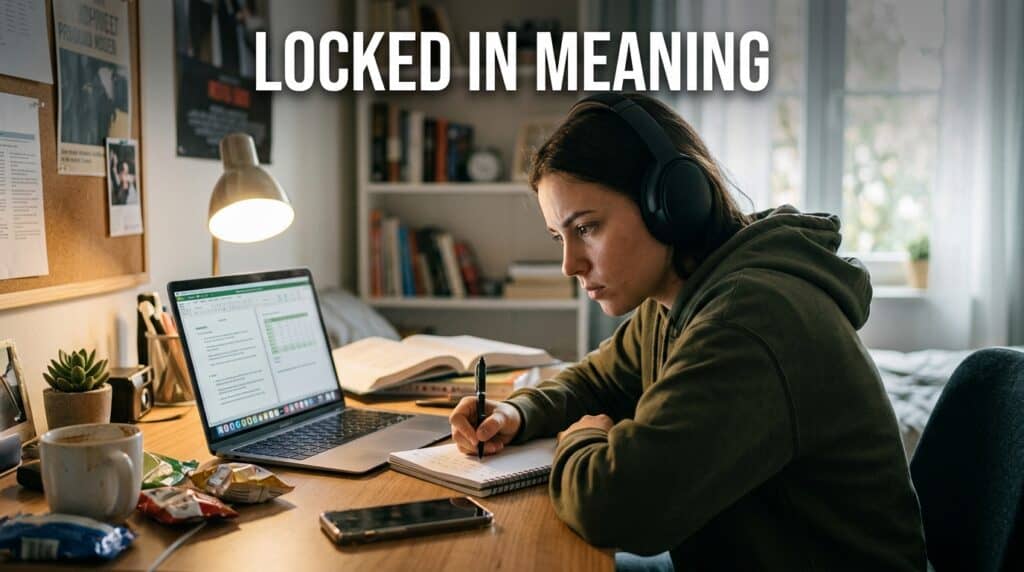
Imagine two students preparing for an exam. One keeps checking messages; the other puts the phone away, reviews notes, and works through practice questions. Someone might describe the second student as “locked in.” The phrase also works for a basketball player making several clutch plays or a gamer concentrating during the last round of a match.
Quick examples: “I’m locked in tonight” means “I’m focusing tonight.” “Bro, lock in” means “Pay attention and take this seriously.” “She was locked in during that game” means “She was performing with intense concentration.”
“Lock in” vs. “locked in”: what is the difference?
| Expression | Meaning | Example |
|---|---|---|
| Lock in | Get serious; focus now | “We have ten minutes left. Lock in.” |
| Locked in | Already concentrating or committed | “I’m locked in on this assignment.” |
| Get locked in | Enter a focused state | “Give me five minutes to get locked in.” |
| Stay locked in | Keep your attention on the goal | “One more round. Stay locked in.” |
There are other, older meanings too. A price, reservation, or decision can be “locked in” when it is fixed or confirmed. “We locked in the hotel rate” is not about intense concentration. The surrounding sentence tells you which meaning applies.
How people use “locked in” on TikTok and in texts
Studying and school
Text exchange: “Coming out tonight?” / “Can’t. Locked in for tomorrow’s chemistry exam.” This is a straightforward way to say studying is the priority. Study-with-me clips may show a tidy desk, a timer, or a phone placed out of reach, with “locked in” in the caption.
Gaming
Voice chat: “We’re down one round. Everyone lock in.” Here it is a rallying call: communicate, pay attention, and try to win. A player might also say “I was so locked in I didn’t hear my phone.”
Sports and fitness
Teammate: “She was locked in for the entire fourth quarter.” It describes concentration under pressure. Fitness captions may use it for consistent training, although the expression does not require extreme dieting, punishing workouts, or ignoring rest.
Work and creative projects
Group chat: “I’m locking in on the presentation until 4.” It tells colleagues or friends you are temporarily prioritizing a task. People also use the phrase when finishing a video edit, practicing an instrument, or preparing for a job interview.
Jokes and exaggerated uses
“I’m locked in” can be deliberately overdramatic. A person might say it before choosing a pizza topping or trying to beat a silly phone game. The joke is that a tiny decision is being treated like a championship moment. Tone, accompanying video, and emojis help distinguish the joke from genuine motivation.
Where did “locked in” come from?
The wording lock in is older than TikTok and has several established English uses, including securing something in place and committing to a choice. Its modern focus-related meaning grew through ordinary speech, including sports talk and gaming communities, before becoming a familiar online motivational caption. It is misleading to say one TikTok creator invented the entire expression.
Sports commentary often describes athletes as “locked in” when they are concentrating and performing well. Competitive gaming uses similar language for serious play. Short-form social media made that phrasing especially visible in videos about studying, workouts, discipline, and personal goals. There is no well-established single first post or precise date when the focus meaning began.
Because the expression appears in different communities, its meaning can shift slightly. In a match, it can describe immediate attention. In a longer-term goal, it can mean commitment over weeks or months. Both are recognizable uses.
What is the “Great Lock In” trend?
“The Great Lock In” is a name used in motivational social media posts for a period of renewed effort toward personal goals, often associated with the final months of a year. Participants may set study, fitness, financial, or creative targets and post progress updates. The label is a loose online challenge, not a formal program with universal rules or an established single organizer.
The useful part of the idea is choosing a specific goal and creating a routine. A person can be “locked in” while taking breaks, sleeping properly, and spending time with friends. Constant hustle is not a requirement of the slang term.
Is “locked in” a compliment or an insult?
Usually it is positive or neutral. Saying someone is locked in praises their concentration or effort. “Lock in!” can be encouraging when a teammate says it before a difficult task. But the same words can sound impatient or critical if they are shouted at someone who is struggling. In some memes, the phrase is sarcastic.
Compare “You’re cooked” (you may be in trouble or exhausted) with “You’re locked in” (you are focused and ready). Online motivation language also overlaps with sigma jokes and aura farming, but those phrases have different meanings. If someone says “go touch grass,” they are suggesting a break from the online world, not telling you to focus harder.
How to use it naturally
- Use “I’m locked in” when you are already concentrating: “I’m locked in on my portfolio today.”
- Use “Time to lock in” when you are about to begin: “The deadline is Friday. Time to lock in.”
- Use “Stay locked in” when someone needs to maintain focus: “You’ve got this. Stay locked in.”
- Use it playfully when the stakes are obviously low: “I’m locked in for this board game.”
It is casual language, so “focused,” “committed,” or “concentrating” may be better choices in a formal report. Also, do not confuse the motivational expression with being physically locked inside a place or with a locked-in financial rate.
Frequently asked questions
What does “lock in” mean on TikTok?
It generally means stop getting distracted and concentrate on a goal or task. It may appear in serious productivity videos or in ironic memes about small everyday decisions.
What does “I’m locked in” mean in a text?
The sender is saying they are focused, determined, or unavailable because they are prioritizing something. Ask what they are working on if the context is unclear.
Does “locked in” mean the same as “in the zone”?
They overlap, but “in the zone” often emphasizes the feeling of effortless concentration, while “locked in” can also emphasize a deliberate decision to commit and work hard.
Is “locked in” only Gen Z slang?
No. Younger social media users helped popularize the motivational use online, but the phrase and related uses predate current TikTok trends and are not exclusive to one generation.
Does “locked in” mean someone is obsessed?
Not necessarily. It usually signals focus or commitment, which may be short-term and healthy. Calling someone obsessed adds a stronger judgment that the phrase itself does not require.
What does “bro lock in” mean?
It is an informal instruction to pay attention, take the situation seriously, or stop making mistakes. Depending on tone, it may be friendly encouragement, frustration, or a joke.
Can “locked in” mean a confirmed plan?
Yes. “Our plans are locked in” means the plans are settled. That is a separate, established use from the internet slang about intense focus.
The bottom line
Locked in = focused and committed. Lock in = get focused. The phrase works for exams, games, sports, creative work, and humorous captions. It is not a promise of perfect productivity, and its focus meaning has roots beyond any single social media trend.