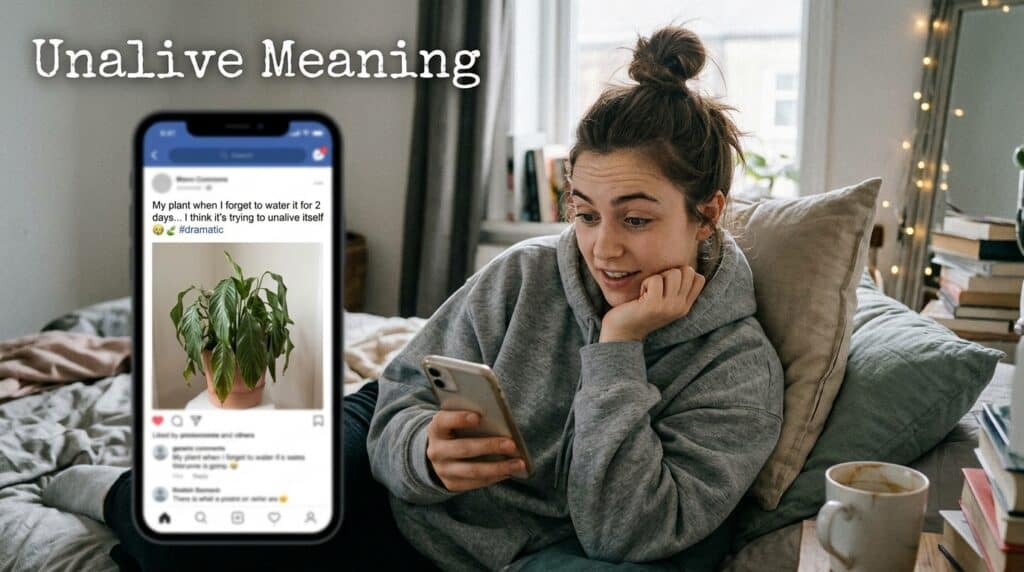
Someone says a character got unalived in a show, or talks about unaliving someone in a game — and you’re wondering why they’re not just saying “died” or “killed.” Let’s break down what this algospeak term actually means.
What Does “Unalive” Mean?
Quick answer: “Unalive” is a euphemism used on social media instead of the words “kill,” “die,” or “dead,” originally so that comments, videos, etc. would not be automatically removed for containing violent or unsuitable content. It’s algospeak — language designed to bypass automated content moderation filters.
Full Definition
Unalive is slang used primarily on social media platforms like TikTok, YouTube, and Twitch to bypass automated content filters that flag or remove posts containing direct references to death, suicide, or murder. The structure adds the prefix “un-” (meaning reverse) to “alive,” forming a euphemistic verb that replaces the word “kill” or “die.” It’s used both as a verb (“to unalive”) and as an adjective (“the unalived character”).
Common Contexts
You’ll see “unalive” used in TikTok comments, YouTube video descriptions, Twitch chats, Discord servers, and everyday conversation when someone is discussing death, killing, or suicide without triggering content moderation filters.
Alternate Spellings
Written as “unalive,” sometimes paired with “unalived” (past tense), “unaliving” (present participle), or just “no longer living” (alternative euphemism).
How It’s Pronounced
Pronounced exactly as it’s spelled — “un-uh-live,” three syllables, with stress on the second syllable.
Typical Tone
Can range from neutral (discussing fictional deaths) to serious (discussing real-world events) to ironic (joking about game deaths), depending on context and delivery.
Origin and Evolution
When It Became Popular
The term originated in the early 2020s as creators on TikTok, YouTube, and Twitch needed a way to discuss death, suicide, and violence without triggering automated content moderation filters that would demonetize, remove, or shadowban their content. By 2026, it’s recognized in multiple internet slang dictionaries and has entered everyday vocabulary among Gen Z and Gen Alpha.
Platforms or Subcultures
It spread through TikTok, YouTube, Twitch, Discord, and gaming communities, particularly in content discussing death, violence, or sensitive topics where creators needed to bypass filters. It’s also heavily used in everyday conversation and meme culture.
How It Evolved Over Time
What started as a specific content moderation workaround broadened into a general-purpose euphemism for death and killing. By 2026, it had stabilized as permanent internet slang, often referenced alongside other algospeak terms and euphemisms.
Modern Usage and Examples
Discussing fictional deaths
“The character got unalived in the finale.”
Gaming context
“I unalived the whole enemy team.”
Discussing real events
“Three people were unalived in the incident.”
Ironically
“That plot twist unalived me.”
Who Uses It?
“Unalive” is used heavily by Gen Z and Gen Alpha on TikTok, YouTube, Twitch, Discord, and gaming communities. It’s also common in content creation, streaming, and everyday conversation where creators discuss sensitive topics without triggering filters.
Example Sentences
“Don’t unalive yourself, please reach out for help.”
“The villain unalived the hero in the final battle.”
“That jump scare almost unalived me.”
Similar Slang Terms
- Cap – a lie or exaggeration, another algospeak-adjacent term used to bypass filters.
- Sus – suspicious or questionable, often used in content moderation contexts.
- Algospeak – the broader category of coded language used to bypass content filters, which unalive falls under.
- No longer living – an alternative euphemism for dead, used similarly to unalive.
- Passed – the classic, non-slang way of describing death euphemistically.
Pop Culture, Memes, and Trends
Memes
“Unalive” memes often feature screenshots of game deaths or plot twists captioned “unalived” or “that unalived me,” often paired with gaming or TV humor.
TikTok Trends
Creators film “unalive” videos discussing fictional deaths or game content, often with captions about bypassing filters or discussing sensitive topics.
Celebrity Content
Several streamers, influencers, and content creators have referenced “unalive” in posts and videos, often as a way to discuss death without triggering filters, helping normalize the term in mainstream contexts beyond just content moderation.
Twitter/X Jokes or Instagram Captions
On X, “unalive” frequently appears in replies to death-related posts, often with comments like “unalived” or “that unalived me.”
Is “Unalive” Safe to Use?
Yes, it’s completely casual and non-offensive as a euphemism for death or killing. It’s widely used in content creation, gaming, and everyday conversation and casual conversation alike, though it can come across as dismissive if aimed at someone’s genuine grief rather than discussing fictional or game deaths.
Why It’s Popular
“Unalive” resonates because it gives creators a way to discuss death, suicide, and violence without triggering automated content filters that would demonetize, remove, or shadowban their content. Its utility as algospeak is why it’s stabilized as permanent slang rather than burning out like typical viral trends.
So next time you need to discuss death without triggering filters, just remember: use unalive. Keep exploring the world of slang, and who knows what other gems you’ll uncover!
Frequently Asked Questions
What does “unalive” actually mean?
It’s a euphemism used on social media instead of the words “kill,” “die,” or “dead,” originally so that comments, videos, etc. would not be automatically removed for containing violent or unsuitable content. It’s algospeak — language designed to bypass automated content moderation filters.
Where did “unalive” come from?
The term originated in the early 2020s as creators on TikTok, YouTube, and Twitch needed a way to discuss death, suicide, and violence without triggering automated content moderation filters that would demonetize, remove, or shadowban their content. By 2026, it’s recognized in multiple internet slang dictionaries.
Why do people say “unalive” instead of “die”?
People say “unalive” to bypass automated content filters on platforms like TikTok, YouTube, and Twitch that flag or remove posts containing direct references to death, suicide, or murder. Using “unalive” helps creators avoid demonetization, removal, or shadowbanning.
Can “unalive” be used seriously?
Yes — while it’s often used ironically or in gaming contexts, it can also be used seriously when discussing real-world events or sensitive topics. Context determines whether it’s ironic, neutral, or serious.