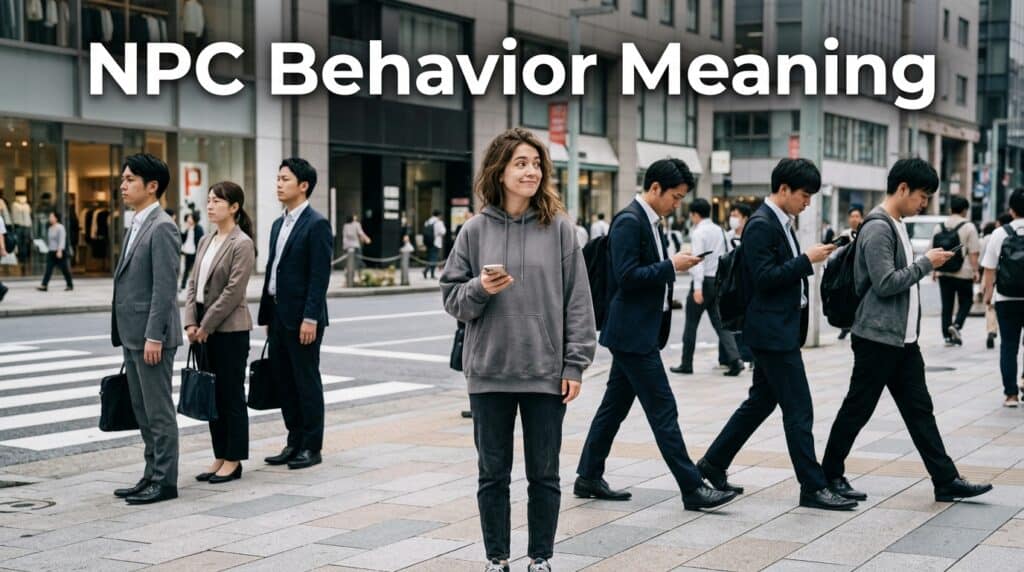
Someone posts generic content, repeats popular opinions word-for-word, or follows trends blindly — and the comments call it NPC behavior. It’s one of the internet’s most popular insults of 2026. Let’s break down what it actually means.
What Does “NPC Behavior” Mean?
Quick answer: “NPC behavior” describes acting like a programmed video game character — predictable, unoriginal, going through the motions without independent thought. It’s used to call out people who follow trends blindly or repeat popular opinions without thinking.
Full Definition
NPC behavior is slang for acting like a non-player character from a video game — someone who seems to lack independent thought, originality, or personality. It implies you are predictable, boring, and just going through the motions like a programmed background character.
Common Contexts
You’ll see “NPC behavior” used in TikTok comments, Twitter/X threads, Instagram captions, and everyday conversation when someone is calling out unoriginal content, predictable responses, or trend-following without independent thought.
Alternate Spellings
Written as “NPC behavior,” sometimes shortened to just “NPC” or paired with “NPC energy” (the vibe of being unoriginal) and “main character energy” (the opposite).
How It’s Pronounced
Pronounced exactly as it’s spelled — “N-P-C be-hav-yor,” saying each letter individually.
Typical Tone
Almost always critical or mocking — it’s meant to call out unoriginality and predictability, not celebrate it. People use it to roast generic content or predictable behavior.
Origin and Evolution
When It Became Popular
The term originated from video game culture (NPC = non-player character) and migrated to internet slang around 2018-2019. It went viral on TikTok and Twitter/X in 2023-2026 as a way to call out unoriginal content, predictable responses, and trend-following without independent thought.
Platforms or Subcultures
It spread through TikTok, Twitter/X, Instagram, and gaming communities, particularly in commentary, reaction, and critique content where creators called out unoriginal behavior. It’s also heavily used in political and culture war discussions.
How It Evolved Over Time
What started as a specific insult about unoriginality broadened into a general-purpose term for any predictable, programmed-seeming behavior. By 2026, it had stabilized as permanent internet slang, often referenced alongside “main character energy” and other character-based metaphors.
Modern Usage and Examples
Calling out unoriginal content
“This is such NPC behavior — she just repeated the same talking points as everyone else.”
Mocking predictable responses
“His whole personality is NPC behavior — same responses, same opinions, zero originality.”
Critiquing trend-following
“Following every trend without thinking is peak NPC behavior.”
Describing the behavior
“I’m having an NPC day — just going through the motions, zero independent thought.”
Who Uses It?
“NPC behavior” is used heavily by Gen Z and Millennials on TikTok, Twitter/X, Instagram, and gaming communities. It’s also common in commentary, reaction, and critique content where creators call out unoriginal behavior.
Example Sentences
“She has NPC energy — just repeats whatever’s trending without thinking.”
“His whole feed is NPC behavior — same captions, same poses, zero personality.”
“I’m done with NPC behavior — time to start thinking for myself.”
Similar Slang Terms
- Main character energy – confident, protagonist-level self-assurance; the opposite of NPC behavior.
- Aura – perceived coolness or charisma, sometimes referenced when someone’s NPC behavior costs them aura points.
- Mid – average, unimpressive, mediocre; often paired with NPC behavior in critiques.
- Sheep – the classic, non-slang way of describing the same trend-following without independent thought.
- Basic – describes the same unoriginal, mainstream-following behavior that NPC behavior critiques.
Pop Culture, Memes, and Trends
Memes
“NPC behavior” memes often feature screenshots of generic content or predictable responses captioned “NPC behavior” or “zero originality.”
TikTok Trends
Creators film “NPC vs. main character” videos showing the difference between unoriginal, predictable behavior and authentic, independent thinking.
Celebrity Content
Several influencers and commentators have referenced “NPC behavior” in posts and videos, often critically, helping normalize the term in mainstream contexts beyond just gaming culture.
Twitter/X Jokes or Instagram Captions
On X, “NPC behavior” frequently appears in replies to unoriginal posts, often with comments like “NPC behavior” or “zero independent thought.”
Is “NPC Behavior” Safe to Use?
It’s casual and generally non-offensive as a critique of unoriginality or predictability. That said, using it to mock someone’s genuine personality or neurodivergence can come across as ableist or mean-spirited, so read the room before using it as a callout.
Why It’s Popular
“NPC behavior” resonates because it names a universal frustration — the annoyance of watching people follow trends blindly or repeat popular opinions without thinking. Its gaming metaphor makes it a vivid, relatable way to call out unoriginality. That’s why it’s stabilized as permanent slang rather than burning out like typical viral trends.
So next time you see someone repeating the same talking points as everyone else, just remember: that’s peak NPC behavior. Keep exploring the world of slang, and who knows what other gems you’ll uncover!
Frequently Asked Questions
What does “NPC behavior” actually mean?
It describes acting like a programmed video game character — predictable, unoriginal, going through the motions without independent thought. It’s used to call out people who follow trends blindly or repeat popular opinions without thinking.
Where did “NPC behavior” come from?
The term originated from video game culture (NPC = non-player character) and migrated to internet slang around 2018-2019. It went viral on TikTok and Twitter/X in 2023-2026 as a way to call out unoriginal content, predictable responses, and trend-following without independent thought.
What is an NPC in video games?
In video games, an NPC (non-player character) is any character controlled by the game’s programming rather than by a real person. They typically have predictable behaviors, limited dialogue, and no independent thought — hence the insult.
Can “NPC behavior” be used self-deprecatingly?
Yes — it’s commonly used self-deprecatingly to acknowledge your own unoriginal or predictable behavior, like “I’m having an NPC day” or “that was peak NPC behavior from me.”