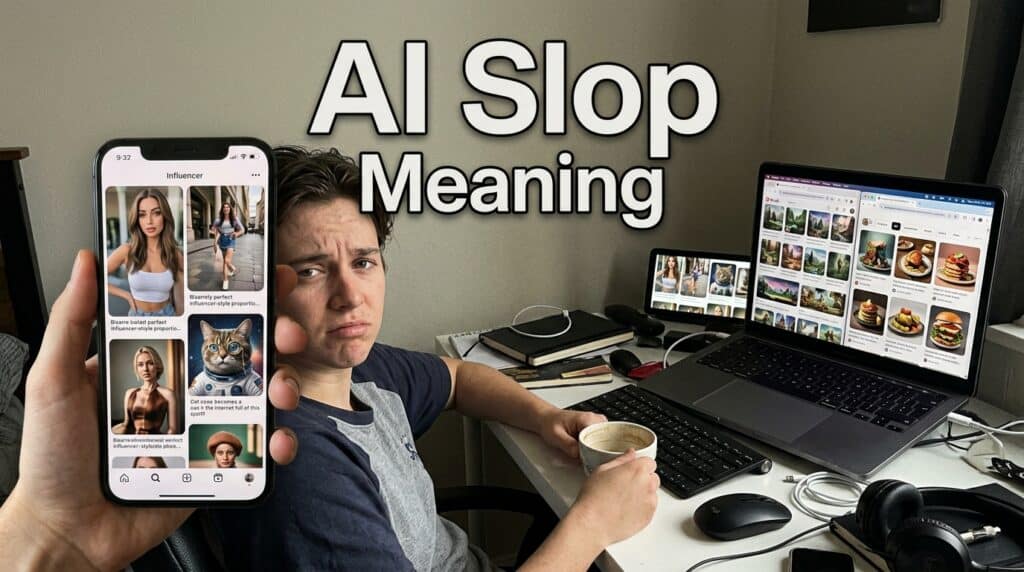
Your feed is flooded with weirdly glossy AI-generated images, nonsensical “Shrimp Jesus” posts, and YouTube videos with robotic narration and zero substance. There’s a name for all of it now: AI slop. Let’s dive into what the term means, where it came from, and why it was just named an official Word of the Year.
What Does “AI Slop” Mean?
Full Definition
“AI slop” refers to low-quality, mass-produced content — text, images, or video — made with generative AI that sounds or looks fluent but lacks real substance, effort, or meaning. It’s usually created in bulk purely to chase clicks, views, or ad revenue rather than to genuinely inform or entertain.
Common Contexts
You’ll see “AI slop” used to describe spammy Facebook images, formulaic AI-written articles, low-effort YouTube explainer videos, AI-generated “news” sites, and flooded search results that all say the same generic thing.
Alternate Spellings
Often shortened to just “slop” on its own, as in “that’s just slop” or “stop posting slop.”
How It’s Pronounced
Pronounced exactly as it’s spelled — “AI slop,” rhyming with “stop” or “mop.”
Typical Tone
Almost always dismissive and critical. It’s a term people use to call out and mock low-quality content, rarely to describe something neutrally.
Origin and Evolution
When It Became Popular
“Slop” is a centuries-old word originally meaning soft mud, later food waste fed to pigs, and eventually general “rubbish.” Internet communities on 4chan, Hacker News, and YouTube repurposed it around 2022 as a dismissive label for early AI image generator output. British programmer Simon Willison is widely credited with popularizing “slop” for AI content specifically in a May 2024 blog post, arguing it should function the way “spam” did for unwanted email.
Platforms or Subcultures
The term spread from tech-forward communities like Hacker News into mainstream social media as AI-generated content increasingly flooded Facebook, X, and YouTube, often aimed at older or less tech-savvy audiences who couldn’t easily tell it was AI-made.
How It Evolved Over Time
“AI slop” grew from a niche insider term into a household phrase fast enough that Merriam-Webster, the American Dialect Society, and Australia’s Macquarie Dictionary all named it their Word of the Year for 2025, cementing it as the go-to term for the flood of low-quality AI content across every major platform.
Modern Usage and Examples
Sincere
“This whole article reads like AI slop — no sources, no depth, just filler.”
Sarcastic
“Oh look, another AI slop image of a cat wearing seventeen different hats.”
Ironic
“I made this deliberately terrible AI slop just to see how many likes it gets.”
Frustrated
“Every search result is AI slop now, I can’t find a real answer anywhere.”
Who Uses It?
“AI slop” is used broadly across all age groups, but especially by journalists, tech commentators, artists, and everyday social media users frustrated by low-quality content flooding Facebook, X, YouTube, and search engines.
Example Sentences
“That whole channel is nothing but AI slop — same script, different topic every video.”
“My aunt keeps sharing AI slop photos of impossible animal hybrids on Facebook.”
“Half the top search results for this topic are just AI slop with no real sourcing.”
Similar Slang Terms
- Brain rot – the mental fog associated with consuming too much low-quality content, often AI slop itself.
- Shitpost – deliberately low-effort, often ironic content, though usually human-made rather than AI-generated.
- Clickbait – the older, pre-AI cousin of slop, focused on misleading headlines rather than fabricated substance.
- Spam – the direct historical parallel Simon Willison referenced when coining slop’s modern usage.
- Deepfake – a more specific, often more harmful category of AI-generated content that can overlap with slop.
Pop Culture, Memes, and Trends
Memes
The infamous “Shrimp Jesus” image — an AI-generated, biblically-styled crustacean — became the unofficial mascot of AI slop on Facebook, symbolizing the bizarre, algorithm-bait content flooding the platform.
TikTok Trends
Creators have built entire video series around “spotting the AI slop,” picking apart telltale signs like extra fingers, nonsensical text, or overly smooth, uncanny imagery.
Celebrity Content
Tech journalists and commentators, including several prominent YouTubers, have used “AI slop” repeatedly in videos and articles criticizing AI-generated news sites, fake celebrity content, and low-effort automated channels.
Twitter/X Jokes or Instagram Captions
On X, “slop” has become shorthand for entire threads mocking obviously AI-written replies, bots, and image posts, often just replying “slop” as a one-word dismissal.
Is “AI Slop” Safe to Use?
Yes, it’s completely casual and non-offensive as a critique of content quality. It’s widely used in professional tech journalism and casual conversation alike, though it can come across as dismissive if aimed at someone’s genuine creative work rather than obvious low-effort mass content.
Why It’s Popular
“AI slop” caught on because it names a problem millions of people were already feeling but couldn’t quite articulate — the flood of hollow, algorithm-chasing content clogging every platform. Its quick rise to Word of the Year status across three major dictionaries shows just how universally recognized the frustration behind it has become.
So next time your feed serves up something a little too glossy and a little too empty, you’ll know exactly what to call it. Keep exploring the world of slang, and who knows what other gems you’ll uncover!