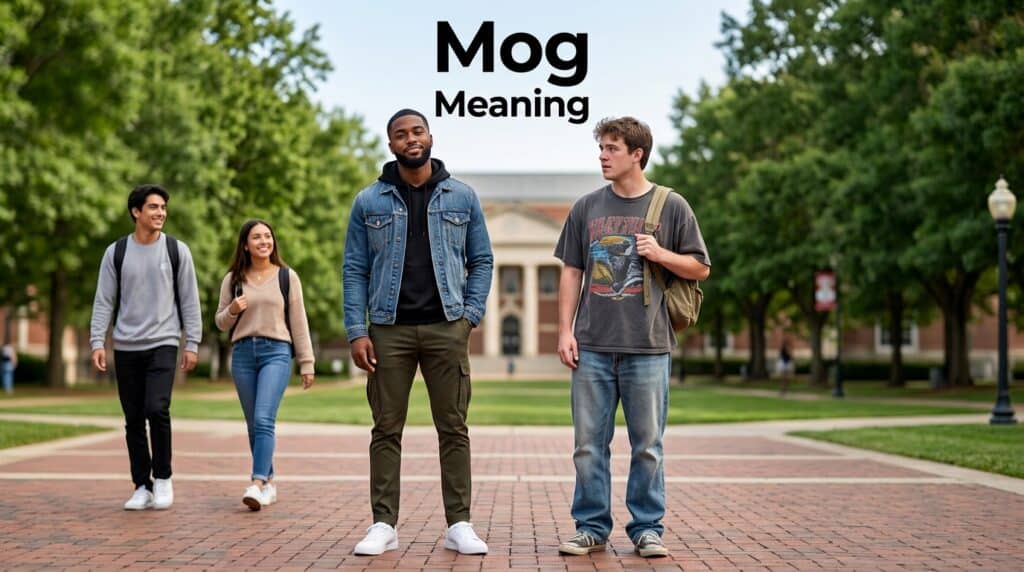
Quick answer: To mog someone is to outshine or outperform them so noticeably that they look less impressive by comparison. Mogging is the act of doing that; to get mogged is to be the person who gets outshone. The word often refers to appearance, height, physique, clothes, or confidence, but people also use it jokingly about sports, cooking, gaming, and almost anything else.
For example, “She mogged everyone at the party with that outfit” means her look stood out. “My homemade pizza got mogged by his” means the speaker thought the other pizza was much better. It is a comparison, not necessarily an intentional act.
What does mog mean in slang?
Mog is usually a verb: “He mogged me in the group photo.” It can also be used as a noun in some online conversations. The central idea is relative advantage: someone looks or performs better beside someone else. This is different from simply saying a person looks good. A person can look great without “mogging” anybody, because mogging implies a comparison.
Originally, the comparison was heavily focused on physical appearance and perceived status. Today, social media users sometimes exaggerate it for comic effect. A cat looking majestic in a family selfie can “mog” its owner. A beautifully decorated cake can “mog” the one next to it. These uses are playful, not literal rankings of human worth.
Mog, mogging, mogged, and mogger
- Mog: “That jacket mogs my whole wardrobe.”
- Mogging: “She’s mogging everyone in the graduation pictures.”
- Mogged: “I got mogged in the team photo.”
- Mogger: A person described as regularly outshining others, especially in appearance-focused meme communities.
The pronunciation is roughly mog, rhyming with “fog.” In online posts, users may add playful compounds such as height-mogging, frame-mogging, or style-mogging to specify what is being compared.
Mogging examples in texts and TikTok comments
These are original, illustrative conversations rather than quotes from actual users.
Example 1: A compliment about an outfit
Alex: “Did you see Maya’s red-carpet photos?”
Sam: “Yeah, that suit mogged every other look.”
Here the speaker praises an outfit by comparing it with the others. It is enthusiastic, but still competitive.
Example 2: A self-deprecating joke
Jamie: “Why does my dog look more photogenic than me?”
Riley: “He mogged you in your own selfie.”
The joke works because the comparison is absurd and affectionate.
Example 3: Fitness or appearance comparison
Chris: “I stood next to a professional bodybuilder at the gym.”
Pat: “You got frame-mogged.”
Frame-mogging refers to a comparison of body size or build. In serious appearance-ranking spaces, this kind of language can be unnecessarily harsh.
Example 4: Beyond appearance
Lee: “I thought my presentation was good until hers started.”
Dev: “She mogged the whole class with those slides.”
This newer, broad use means “outperformed” rather than “looked more attractive.”
Where did mogging come from?
The most widely reported explanation traces mog to AMOG, short for “alpha male of the group,” an expression used in pickup-artist and manosphere communities. The language developed in online spaces that compared men by looks, confidence, and supposed social dominance. The idea of an objective “alpha” ranking is a social claim from those communities, not a scientific measure of attractiveness or worth.
Documented examples of mogging appear in fitness-board discussions by at least 2016. The precise first person to coin the shortened verb is not established, so it would be misleading to credit a single TikToker or one specific forum post with inventing it. From niche appearance and bodybuilding conversations, the word spread into memes, short-form video, and everyday online joking during the 2020s.
On November 3, 2026, Collins announced “mogging” as its 2026 Word of the Year, reflecting its mainstream use for outshining someone or something in looks, confidence, or performance. That recognition does not mean the word was invented in 2026; it had circulated for years.
For the history and changing usage, see Dictionary.com’s slang explainer, Know Your Meme’s documentation, and the November 2026 Collins announcement coverage.
Mogging vs. looksmaxxing, rizz, aura, and glow-up
| Term | What it emphasizes | Example |
|---|---|---|
| Mogging | Outshining someone in a comparison | “Her outfit mogged mine.” |
| Looksmaxxing | Trying to improve one’s appearance | “He’s focused on skincare and fitness.” |
| Rizz | Charm or flirting ability | “She’s got effortless rizz.” |
| Aura | Perceived coolness or presence | “That entrance gave him aura.” |
| Glow-up | Change or improvement over time | “Her style had a glow-up.” |
These terms overlap in memes but are not interchangeable. A glow-up is about change over time, while mogging is about comparison. Rizz refers to charisma rather than a physical contest. Someone with strong aura may command attention without being more conventionally attractive. Sigma belongs to a related internet-masculinity meme vocabulary but describes a persona, not the act of outshining somebody.
Is mogging a compliment or an insult?
It depends on the target and tone. “Your outfit mogged everyone else’s” can be a compliment. “You got mogged by the guy standing next to you” can be an insult, especially when it mocks somebody’s face, body, height, or perceived attractiveness. Friends sometimes use the word ironically, but a public comparison can still embarrass the person being discussed.
The term also carries baggage from online communities that obsessively rank appearances. Some “looksmaxxing” content presents subjective beauty standards as scientific scores or promotes risky practices. A casual joke about being outdressed is not the same as endorsing that worldview. If you are talking about real people, it is usually kinder to praise the standout person without turning someone else into the loser.
How to use mog naturally
Use it in casual chats, meme captions, or reactions when the comparison is obvious. A phrase such as “This sequel mogs the original” sounds like informal internet commentary, not professional writing. Avoid using it in workplace feedback, formal reviews, or situations where the person being compared might feel singled out. When in doubt, “outshines,” “stands out,” or “outperforms” is clearer.
Frequently asked questions
What does “I got mogged” mean?
It means the speaker felt outshone by someone else, commonly in a photo or appearance comparison. It can be a serious complaint or a self-deprecating joke.
Does mog mean “man of God”?
Not in this slang sense. Some unrelated acronyms use MOG for other phrases, but the common internet verb mog is associated with AMOG and outshining someone. Context matters.
What is height-mogging?
It means appearing taller than another person, often in a photo or when standing side by side. It describes a comparison, not a person’s value.
What is frame-mogging?
It means outshining someone in body frame, shoulder width, or muscular build, especially in fitness-related memes.
Can women mog someone?
Yes. Although the term emerged in male-centered communities, people now use it about anyone and even about nonhuman things, such as outfits, meals, or performances.
Is mogging always about attractiveness?
No. Appearance remains a common meaning, but contemporary use also includes outperforming or outclassing someone in sports, fashion, gaming, cooking, or other activities.
Is mogging a new word in 2026?
No. It was documented online years earlier. Collins choosing “mogging” as its 2026 Word of the Year marks increased visibility, not the word’s invention.
Bottom line: Mogging means noticeably outshining somebody. The same phrase can be playful praise or a hurtful putdown, so pay attention to the comparison and the people involved.