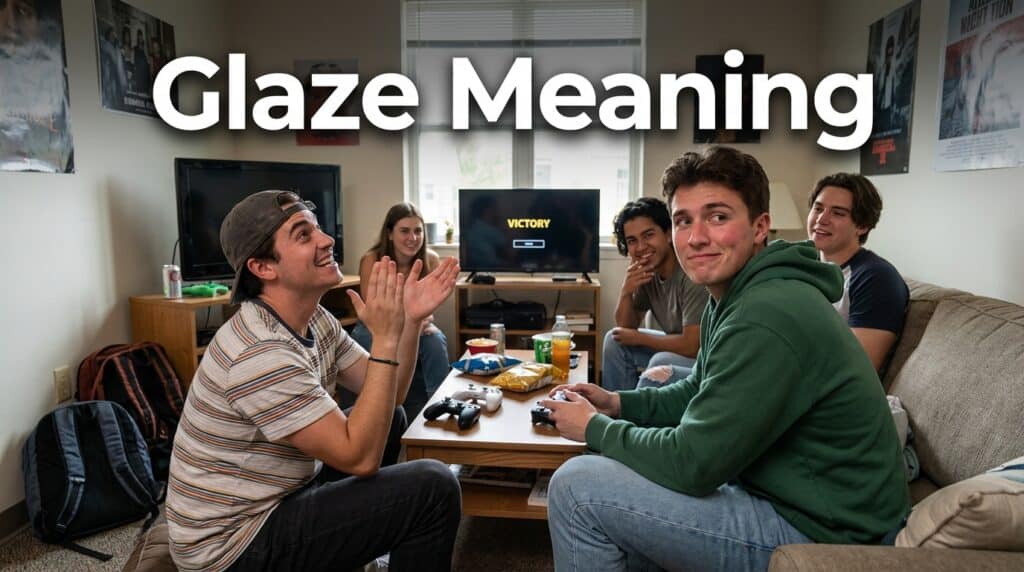
Quick answer: In internet slang, glazing means praising, hyping or defending someone so excessively that it comes across as biased, embarrassing or insincere. A glazer is the person doing it. If someone replies “stop glazing,” they think your compliments have gone too far. The accusation can be serious, but among friends it is often playful.
Picture a basketball fan insisting their favorite player has never made a bad decision, or a streamer’s chat calling every ordinary move “legendary.” Other people might respond, “The glazing is crazy.” They are criticizing the amount of praise, not necessarily the person receiving it.
What Does Glazing Mean in Slang?
To glaze someone is to lay on compliments so thickly that the speaker seems unable—or unwilling—to offer a balanced opinion. It can involve flattery, exaggerated admiration, defending someone against any criticism or trying too hard to win their approval.
Glazing does not automatically mean that a compliment is dishonest. Sometimes the admirer genuinely believes what they say; the person calling it glazing simply thinks the enthusiasm is disproportionate. That distinction matters: “You’re glazing” is a judgment about somebody else’s praise, not proof of their motives.
| Expression | Meaning | Example |
|---|---|---|
| Glaze | To overpraise or excessively flatter | “You glaze that team every game.” |
| Glazing | The behavior of overhyping someone | “The glazing in these comments is unreal.” |
| Glazer | A person accused of excessive praise | “He’s such a glazer for that streamer.” |
| Stop glazing | Dial back the exaggerated compliments | “It was one good shot. Stop glazing.” |
| Self-glazing | Overhyping yourself, often as a joke | “Let me self-glaze: I cooked that presentation.” |
What Does “Stop Glazing” Mean?
“Stop glazing” means “stop praising that person so much” or “be more objective.” You might hear it after someone gives an ordinary performance a wildly enthusiastic review. The speaker could be teasing a friend or genuinely objecting to what they see as favoritism.
For example, one friend says, “That was the greatest three-pointer in basketball history.” Another replies, “It was a wide-open shot. Stop glazing.” The reply suggests the first friend is exaggerating. It does not necessarily mean the shot was bad.
Glazing Examples in Texts, TikTok and Real Life
In a group chat
A: “Our friend’s cooking deserves a Michelin star. Every meal is flawless.”
B: “I liked dinner too, but you’re glazing now.”
In a TikTok comment section
Comment: “This creator has literally never posted a bad video.”
Reply: “The glazing is wild.”
In gaming
A: “That player carried the entire team. Nobody else mattered.”
B: “You’re glazing. The support player saved the round twice.”
In sports fandom
A: “My favorite striker is better than every legend combined.”
B: “Bro, stop glazing.”
Self-aware or affectionate use
“Not to glaze, but her new album is fantastic.” Here, the speaker anticipates the accusation and signals that the compliment is enthusiastic but sincere. Friends may also jokingly say “I’m glazing” while openly celebrating somebody they admire.
Where Did Glazing Slang Come From?
The modern online use can be traced to late 2021, though its exact invention cannot be established beyond doubt. Know Your Meme’s documented history reports uses in a Discord server in November 2021 and an early public post on X/Twitter dated November 24, 2021. Its account draws in part on statements from people associated with that Discord community, so those claims should be understood as documented early examples rather than absolute proof nobody used the expression earlier.
During 2022, the term became more visible in streaming and gaming communities. Clips involving streamers such as Kai Cenat, Duke Dennis and xQc helped spread it, and by 2023 it was familiar in TikTok comment sections, sports discussions and fan communities. Dictionary.com’s April 6, 2026 slang entry likewise traces circulation to around 2021 and describes the term as excessive praise.
Why glaze? A literal glaze is a coating, such as the sweet layer on a doughnut. The slang plays on the image of covering somebody in praise. It also developed in communities that used cruder expressions for over-the-top flattery, so the doughnut explanation is a useful visual metaphor, not a complete or certain etymology. The word’s online history is more specific than simply saying “TikTok invented it.”
Glazing vs. Simping vs. Stanning
These expressions overlap, but they are not identical. Simp commonly suggests excessive attention or devotion, especially toward someone a person is attracted to. Stan refers to an especially devoted fan; depending on context, it can be neutral or proudly self-applied. Glazer focuses on how exaggerated, uncritical or approval-seeking the praise sounds, whether the target is a crush, athlete, musician, gamer or even a company.
For instance, you might stan an artist by following their releases, yet criticize a weak song. Someone might call you a glazer if you insist every track is a masterpiece and attack anyone who disagrees. Likewise, admiring a person’s aura or charisma is not automatically glazing; the difference is whether the compliments feel excessive.
Is Glazing an Insult?
Usually, yes—at least mildly. Calling someone a glazer implies they are overdoing their praise, acting biased or sucking up. In a close friend group it may be light teasing. In an argument, it can be a dismissive way to avoid engaging with a legitimate opinion. Context, relationship and tone determine how harsh it feels.
The word itself is not a swear word, but its slang history overlaps with more sexually explicit expressions. It is best suited to casual conversation rather than a professional review, classroom feedback or an important disagreement. If somebody is simply excited about a person’s work, calling them a glazer may be unfair.
Can Glazing Be Positive?
Sometimes people reclaim the term jokingly: “I’m going to glaze my best friend because she deserves it.” Others use self-glazing to describe hyping themselves up. Those uses are playful inversions of the usual criticism, not the main definition. When you see the word without extra context, assume it refers to excessive praise rather than a straightforward compliment.
Frequently Asked Questions
What does glazing mean on TikTok?
It means excessively praising or defending a person, creator, athlete or idea. Commenters often use it to mock uncritical fans.
What is a glazer?
A glazer is somebody accused of flattering, defending or hyping another person far beyond what seems reasonable.
What does “stop glazing bro” mean?
It is an informal way of saying, “Stop exaggerating how amazing they are.” It can be teasing or dismissive.
Does glazing mean lying?
Not necessarily. A person can genuinely admire someone and still be accused of glazing because the praise sounds exaggerated.
Is glazing the same as simping?
No. Simping often involves romantic or attraction-related devotion. Glazing can involve any target, including sports teams, streamers and friends.
Did glazing originate on TikTok?
No. Documented examples appear in Discord and on X/Twitter in 2021, before the slang became prominent in Twitch clips and TikTok comments.
What does “not to glaze” mean?
It introduces enthusiastic praise while acknowledging that it might sound excessive: “Not to glaze, but that performance was incredible.”
Is “glazing” always bad?
No. Friends sometimes use it jokingly or proudly, and sincere enthusiasm is not inherently wrong. The usual slang meaning is still critical of excessive praise.
The Bottom Line
Glazing is internet slang for praise that seems over-the-top, uncritical or designed to impress. A glazer is the enthusiastic admirer; “stop glazing” is the callout. The expression circulated in online communities by 2021 and spread through streaming and social media. Use it with some care: a genuine compliment is not automatically glazing.