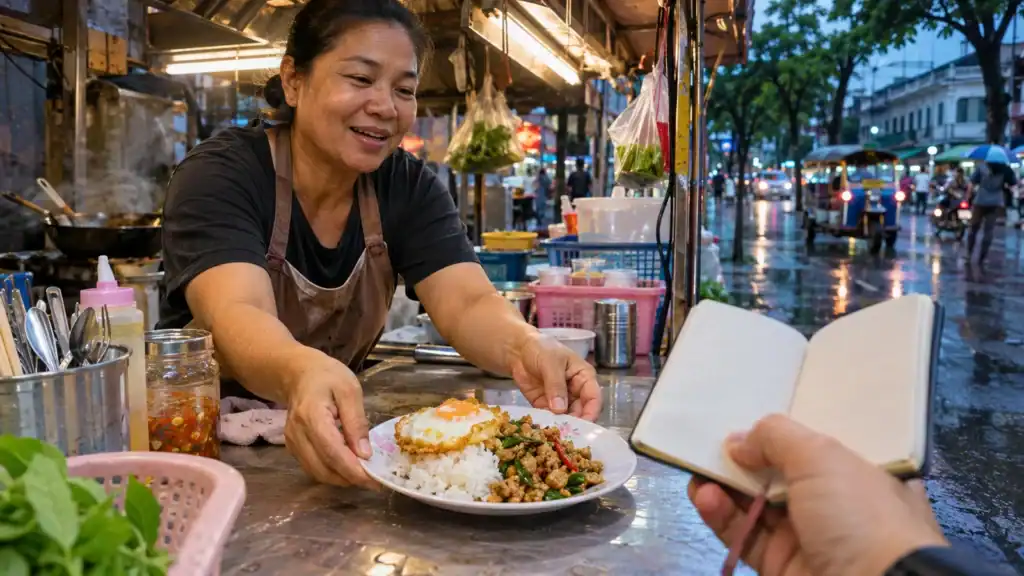
You can get a lot done in Thailand with a few words and a gesture. At a food stall, point at what you want and say ao an ni (“I’ll take this one”). At a market, ask an ni thao rai (“How much is this?”). If an answer comes back faster than you can follow, there’s a phrase for that too.
Here are 32 basic Thai phrases for travelers, with Thai script you can show on your phone and simple romanization you can read aloud. Start with the three below, then skip to the situation you’re in.
Three Thai phrases to learn first
- Hello. สวัสดีครับ / สวัสดีค่ะ (sawat di khrap / sawat di kha).
- Thank you. ขอบคุณครับ / ขอบคุณค่ะ (khop khun khrap / khop khun kha).
- Where’s the restroom? ห้องน้ำอยู่ที่ไหนครับ / ห้องน้ำอยู่ที่ไหนคะ (hong nam yu thi nai khrap / hong nam yu thi nai kha).
How to say these phrases politely
The tables give you the base phrase. Men typically add khrap (ครับ) to polite statements and questions. Women typically add falling-tone kha (ค่ะ) to statements and high-tone kha (คะ) to questions. You may hear men pronounce khrap as khap in everyday speech.
The romanization leaves out tones and vowel length. In the tables, ph is a p with a puff of air, like the p in English pin. Th is a t with a puff of air, like the t in top. Thai uses five tones, so the script is the most useful column to show someone if they’re having trouble understanding you.
Greetings and everyday courtesy
Start with hello, thank you, and excuse me. At a café counter, kho thot is an easy way to get someone’s attention before asking a question.
| English | Thai | How to say it |
|---|---|---|
| Hello | สวัสดี | sawat di |
| Thank you | ขอบคุณ | khop khun |
| Excuse me / sorry | ขอโทษ | kho thot |
| It’s okay / no problem | ไม่เป็นไร | mai pen rai |
| That’s right | ใช่ | chai |
| That’s not right | ไม่ใช่ | mai chai |
If you apologize for brushing past someone and hear mai pen rai, it’s usually a reassurance along the lines of “It’s okay.” After a thank-you, the same phrase can mean “No problem.”
Ordering food and drinks
At a stall, you can point to a dish and say ao an ni (“I’ll take this one”). For a dish made to order, say mai phet when you order. If you specifically want the cook to leave out chilies, say mai sai phrik.
| English | Thai | How to say it |
|---|---|---|
| I’ll take this one | เอาอันนี้ | ao an ni |
| Not spicy, please | ไม่เผ็ด | mai phet |
| A little spicy | เผ็ดนิดหน่อย | phet nit noi |
| Please don’t add chilies | ไม่ใส่พริก | mai sai phrik |
| Plain water, please | ขอน้ำเปล่า | kho nam plao |
| Delicious | อร่อย | a roi |
| Could we have the bill? | เก็บเงินด้วย | kep ngoen duai |
One sound, two jobs. In ไม่เผ็ด (mai phet), the first word means “not.” In เผ็ดไหม (phet mai), the last word turns “spicy” into a question. The two words spelled mai here have different tones and different Thai spellings.
Taxis and directions
If you’re heading to an airport, show the driver the airport name in your booking. In Bangkok, for example, pai sanam bin gets across that you want to go to the airport. Showing the name tells the driver which one.
| English | Thai | How to say it |
|---|---|---|
| To the airport, please | ไปสนามบิน | pai sanam bin |
| Please turn on the meter | ช่วยเปิดมิเตอร์ด้วย | chuai poet mi toe duai |
| Please stop here | จอดตรงนี้ | chot trong ni |
| Go straight | ตรงไป | trong pai |
| Turn left | เลี้ยวซ้าย | liao sai |
| Turn right | เลี้ยวขวา | liao khwa |
Shopping and prices
Use an ni thao rai while pointing to an item. If you can’t catch the price, show the seller your phone’s calculator and ask them to type it in. Save lot dai mai for a market stall where bargaining is welcome.
| English | Thai | How to say it |
|---|---|---|
| How much is this? | อันนี้เท่าไร | an ni thao rai |
| Can you give me a discount? | ลดได้ไหม | lot dai mai |
| I’m just looking | ดูเฉย ๆ | du choei choei |
| Can I pay by card? | จ่ายด้วยบัตรได้ไหม | chai duai bat dai mai |
| No, thank you / I’ll pass | ไม่เอา | mai ao |
Two prices worth recognizing are 50 baht (ห้าสิบบาท, ha sip bat) and 100 baht (หนึ่งร้อยบาท, nueng roi bat).
Hotels and guesthouses
Say chong wai laeo at reception and show your booking confirmation. To ask whether breakfast comes with the room, use ruam a han chao mai.
| English | Thai | How to say it |
|---|---|---|
| I have a reservation | จองไว้แล้ว | chong wai laeo |
| Is breakfast included? | รวมอาหารเช้าไหม | ruam a han chao mai |
| What time is breakfast? | อาหารเช้ากี่โมง | a han chao ki mong |
| What’s the Wi-Fi password? | รหัสไวไฟคืออะไร | rahat wai fai khue a rai |
Asking for help or clarification
If someone replies too quickly, try phut cha cha noi. For a place you need to find, such as a restroom, show the Thai text so the other person can point you in the right direction.
| English | Thai | How to say it |
|---|---|---|
| Where is the restroom? | ห้องน้ำอยู่ที่ไหน | hong nam yu thi nai |
| Do you speak English? | พูดภาษาอังกฤษได้ไหม | phut phasa angkrit dai mai |
| Please speak slowly | พูดช้า ๆ หน่อย | phut cha cha noi |
| Help! | ช่วยด้วย | chuai duai |
Emergency numbers in Thailand. Call 1669 for emergency medical services or 1155 for Tourist Police assistance.
Frequently asked questions
Why do people spell Thai words differently in English?
Romanization systems make different choices about how to represent Thai sounds. You might see sawat di, sawatdee, or sawasdee for the same greeting. Keeping the Thai script alongside the pronunciation gives you a consistent version to show someone.
What’s the difference between mai pen rai and mai ao?
Mai pen rai usually reassures someone or brushes off a small inconvenience. Mai ao means you don’t want something. If a vendor offers you an item and you want to decline, mai ao khrap or mai ao kha is a practical response.
Which phrases should I learn before a first trip?
Practice hello, thank you, and excuse me before you leave. Save the food, directions, and help tables to your phone so you can pull up the Thai text when you need it.