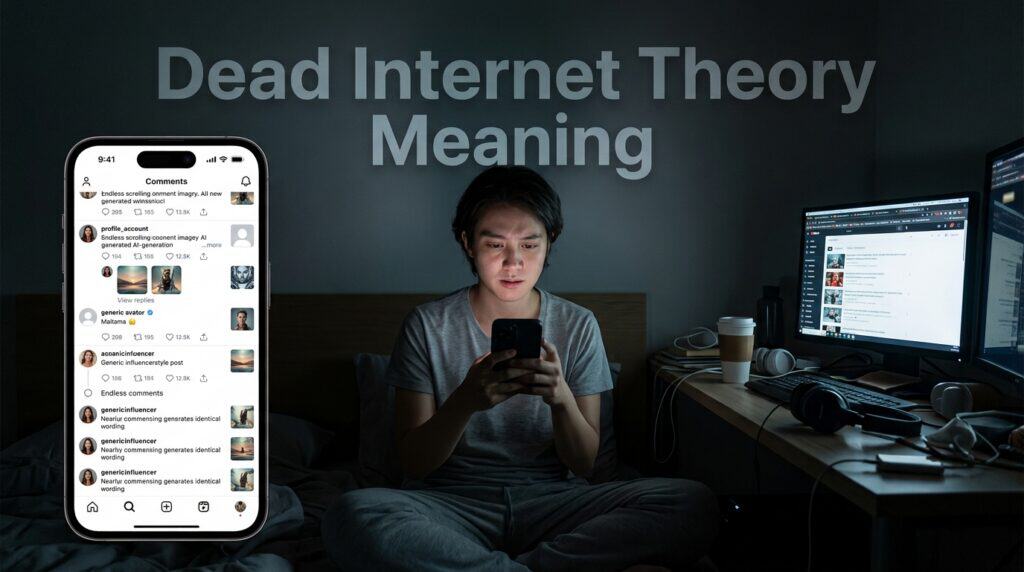
Someone mentions “dead internet theory” in a comment thread and suddenly half the replies are either bots or people arguing about whether bots are real. Let’s break down what this conspiracy theory actually claims and why Cambridge Dictionary just added it in July 2026.
What Does “Dead Internet Theory” Mean?
Quick answer: “Dead internet theory” is the conspiracy theory that most online content is now AI/bot-generated rather than human-created — that the internet “died” years ago and we’re all just interacting with algorithms pretending to be people. It was added to Cambridge Dictionary in July 2026.
Full Definition
Dead internet theory is the belief that the majority of internet traffic, content, and interactions are now generated by AI, bots, or algorithms rather than real humans — that the authentic, human-driven internet “died” sometime in the 2010s and was replaced by automated systems designed to simulate human activity.
Common Contexts
You’ll see “dead internet theory” used in comment sections, tech forums, AI ethics discussions, and social media threads when someone suspects a post, account, or entire platform is dominated by bots or AI-generated content rather than real people.
Alternate Spellings
Written as “dead internet theory,” sometimes abbreviated as “DIT.” Occasionally paired with “AI slop” or “tasteslop” when discussing AI-generated content specifically.
How It’s Pronounced
Pronounced exactly as it’s spelled — “ded in-ter-net thee-uh-ree,” four syllables for “internet,” three for “theory.”
Typical Tone
Can range from genuinely conspiratorial (believing the theory is literally true) to self-aware and humorous (joking about how bot-filled everything feels) to critical (using it as a callout for obvious bot activity).
Origin and Evolution
When It Became Popular
The theory originated on 4chan and other imageboards around 2016-2017, spreading through Reddit and Twitter in the early 2020s as AI-generated content became more prevalent. It was officially added to Cambridge Dictionary on July 27, 2026, as part of a batch of new words related to AI and internet trends.
Platforms or Subcultures
It spread through 4chan, Reddit, Twitter/X, and tech forums where bot detection and AI content discussions are common. It’s also heavily used in AI ethics spaces and conspiracy theory communities where the idea of a “dead” internet resonates with broader distrust of tech platforms.
How It Evolved Over Time
What started as a niche conspiracy theory on imageboards has become mainstream vocabulary for describing the growing sense that online spaces are increasingly dominated by bots, AI, and algorithmic content rather than authentic human interaction. Cambridge Dictionary’s official addition cemented it as the go-to term for this phenomenon.
Modern Usage and Examples
Sincere (conspiratorial)
“This whole subreddit is dead internet theory at this point — I’m convinced 90% of these accounts are bots.”
Self-aware/humorous
“Me arguing with a bot in the comments: peak dead internet theory behavior.”
Critical callout
“This comment section is pure dead internet theory — not a single human take in sight.”
Describing the behavior
“My entire feed is just AI slop and bot accounts — dead internet theory is real.”
Who Uses It?
“Dead internet theory” is used by conspiracy theorists, tech commentators, AI ethics researchers, and everyday social media users frustrated by bot-filled platforms on Twitter/X, Reddit, TikTok, and tech forums. It’s especially common in AI ethics and platform governance discussions about the impact of automation on online spaces.
Example Sentences
“Every time I post something, the first five replies are obvious bots — dead internet theory is winning.”
“This whole platform feels like dead internet theory at this point — nothing feels human anymore.”
“I tried to have a real conversation and got five AI responses — dead internet theory confirmed.”
Similar Slang Terms
- AI slop – low-quality AI-generated content, often cited as evidence for dead internet theory.
- Tasteslop – bland AI-generated aesthetic content, another piece of evidence for dead internet theory proponents.
- Bot – an automated account, the building block of the “dead” internet according to the theory.
- Algorithm – the system believed to be generating most content in the “dead” internet scenario.
- Soulless – describes the same lack of human authenticity that dead internet theory claims dominates the internet.
Pop Culture, Memes, and Trends
Memes
“Dead internet theory” memes often feature screenshots of obvious bot comments or AI-generated posts captioned “dead internet theory in action” or “proof we’re all alone.”
TikTok Trends
Creators film “spotting the bots” videos, picking apart telltale signs of AI-generated comments and accounts, turning the conspiracy theory into a whole detective game.
Celebrity Content
Several tech journalists and AI researchers have publicly discussed dead internet theory in articles and videos about bot detection and AI content prevalence, helping normalize the term in mainstream tech coverage.
Twitter/X Jokes or Instagram Captions
On X, “dead internet theory” frequently appears in replies to obvious bot accounts or AI-generated posts, often with comments like “dead internet theory confirmed” or “we lost the war.”
Is “Dead Internet Theory” Safe to Use?
Yes, it’s completely casual and non-offensive as a descriptive term for the conspiracy theory or as a humorous callout for obvious bot activity. It’s widely used in tech journalism, AI ethics discussions, and casual conversation alike, though it can come across as conspiratorial if used sincerely in non-tech contexts.
Why It’s Popular
“Dead internet theory” resonates because it names a feeling millions of people have daily — the sense that online spaces are increasingly dominated by bots, AI, and algorithmic content rather than authentic human interaction. Cambridge Dictionary’s decision to add it in July 2026 cemented it as the go-to term for this phenomenon, reflecting how central this frustration has become to the modern internet experience.
So next time you’re arguing with what feels like a bot in the comments, just remember: you might be living the dead internet theory. Keep exploring the world of slang, and who knows what other gems you’ll uncover!
Frequently Asked Questions
What does “dead internet theory” actually mean?
It’s the conspiracy theory that most online content is now AI/bot-generated rather than human-created — that the internet “died” years ago and we’re all just interacting with algorithms pretending to be people. It was added to Cambridge Dictionary in July 2026.
Where did “dead internet theory” come from?
The theory originated on 4chan and other imageboards around 2016-2017, spreading through Reddit and Twitter in the early 2020s as AI-generated content became more prevalent. It was officially added to Cambridge Dictionary on July 27, 2026.
Is dead internet theory true?
There’s no evidence that the majority of internet content is bot/AI-generated, though certain platforms and comment sections do have significant bot activity. The theory is generally considered a conspiracy theory rather than a verified fact, though it resonates with real frustrations about bot prevalence.
Why did Cambridge Dictionary add “dead internet theory”?
Cambridge Dictionary added “dead internet theory” because it reflects a growing cultural belief — whether true or not — that online spaces are increasingly dominated by bots and AI rather than authentic human interaction. It’s become the go-to term for describing this phenomenon.